
Home › Anansi the Spider
WHO IS ANANSI?
Anansi the Spider: Meaning, Origins & Mythology
Anansi — known in Akan as Kwaku Ananse — is the clever trickster spider of Ghanaian folktales. He belongs to the Ashanti (Asante) people of Ghana and the wider Akan world, where his adventures are told as Anansesem, “spider stories.” Small and weak but endlessly cunning, Anansi wins against lions, elephants and even the sky god by using his wits — and his tales carry lessons about greed, kindness, courage and the power of a clever mind.

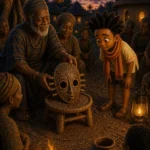
Anansi the spider — trickster, storyteller and teacher of Akan folktales.
What does the name “Anansi” mean?
In the Akan language (Twi), ananse simply means “spider.” You will see the name spelled several ways in English — Anansi, Ananse, Kwaku Ananse, Kweku Anansi — because it has travelled across languages and continents for centuries. They all point to the same character.
The first part, Kwaku (also written Kweku), is an Akan “day name”: it means a boy born on a Wednesday. So Kwaku Ananse is, quite literally, “Ananse the spider, born on Wednesday” — a small, ordinary-sounding name for a character who is anything but ordinary.
HOW TO SAY IT
Anansi is said ah-NAHN-see. The Akan form Ananse is close to ah-NAHN-seh. Both are correct — the spelling usually just tells you whether the storyteller learned the name in Ghana or in the Caribbean.
Where do Anansi stories come from?
Anansi comes from the Ashanti Kingdom of Ghana in West Africa, and from the wider family of Akan peoples who share the Twi language. For hundreds of years, Akan families have gathered in the evening to tell Anansesem — a word that means both “spider stories” and, more broadly, “folktales.” So central is the spider that his name became the name for storytelling itself.
These stories were never just entertainment. Told aloud, with call-and-response songs and a listening circle, Anansesem passed down a community’s values — how to treat guests, why greed backfires, when cleverness is wise and when it goes too far. Anansi is the teacher who never lectures: you laugh at his schemes, and the lesson slips in sideways.
Is Anansi a god?
Not exactly. Anansi is a trickster figure, not a god who is worshipped. But he lives close to the divine: in the tradition he deals directly with Nyame (also called Onyankopơn), the Sky God and creator. Anansi bargains with Nyame, borrows from him, outwits him and sometimes carries messages between the sky and the earth. That is why some retellings call him a “spider god” or a divine trickster — he is a go-between with one foot in the human world and one in the heavens, rather than a deity in his own right.
How Anansi won all the world’s stories
The most famous Anansi tale explains why the stories carry his name. Long ago, all the stories in the world belonged to Nyame the Sky God, locked away in a wooden box. Anansi asked to buy them. Nyame named a price he thought no one could ever pay: bring me Onini the python, Osebo the leopard, the Mmboro hornets, and Mmoatia the fairy whom no one can see.
Anansi was small and weak — so he used his mind. With help from his wife Aso, he tricked the python into being measured against a pole and tied him fast; fooled the leopard into a covered pit; lured the hornets out of the rain into a gourd; and caught the invisible fairy with a sticky doll smeared in tree gum. One by one he carried the impossible price up to the sky. Nyame, astonished, handed over the box — and from that day the stories of the world have been called Anansesem, the spider’s stories.
Anansi’s family
Anansi is a family character. His wife is usually named Aso, a sharp thinker who often supplies the plan behind his tricks. His son Ntikuma is learning his father’s trade — sometimes clever, sometimes the one who gives the game away.
In one much-loved tale, Anansi has several gifted sons — each with a single remarkable talent, from seeing far away to drinking a whole river dry. When Anansi falls into danger, it takes all of their gifts working together to save him — a quiet lesson that even a clever father needs his children, and that no one succeeds entirely alone.
What Anansi teaches: the trickster with a lesson
Anansi is a trickster — the small, clever underdog who survives by outsmarting the strong. That is what makes him beloved: he is proof that brains can beat brawn, and that the powerless are not helpless. But he is not a simple hero. His schemes are often driven by greed or laziness, and just as often they backfire on him. That is the point. Anansi stories hold two lessons at once:
- Cleverness is a gift — wit, patience and a good plan can solve what strength cannot.
- Cleverness has limits — when Anansi is greedy or unkind, his own trick trips him up. Wisdom means knowing when to stop.
- Everyone matters — the smallest creature, or the youngest child, can hold the answer no one else does.
WHY CHILDREN LOVE HIM
Because Anansi is the little one who wins — and because he is allowed to be flawed. Children see themselves in a hero who is small, funny, sometimes naughty, and still capable of changing the whole world with a good idea.
Anansi around the world
Anansi is one of the most far-travelled characters in world folklore. During the transatlantic slave trade, enslaved Akan people carried his stories across the ocean in memory alone — and he survived. In Jamaica and the Caribbean he became “Anancy”, the sly hero of countless island tales. In the American South, echoes of the spider trickster appear as “Aunt Nancy”. Wherever Akan people were taken, Anansi went with them — a small spider who became a symbol of survival, resistance and the unbreakable power of a story.
Anansi: frequently asked questions
What is Ananse Ntontan?
Ananse Ntontan means “the spider’s web.” It is a well-known Adinkra symbol from the Akan people of Ghana, standing for wisdom, creativity and the complexity of life — a fitting emblem for a character whose cleverness weaves everything together.
Why is Anansi a spider?
As a spider, Anansi is tiny and physically weak — yet a spider spins, plans and traps far larger creatures. He is the perfect shape for a trickster whose only real weapon is his mind. Some tales even explain how Anansi came to take his spider form as the result of one of his own schemes.
Is Anansi good or bad?
Both, and that is deliberate. Anansi is a hero you cheer for and a rascal you laugh at. He can be brave and generous, or greedy and selfish — and the stories reward the good and punish the bad, often in the same tale.
What language are Anansi stories told in?
Traditionally in Twi, the language of the Akan people of Ghana, where the tales are called Anansesem. Today they are told and written in many languages, including English, all around the world.
Is Anansi the same as Kwaku Ananse?
Yes. Kwaku Ananse (or Kweku Anansi) is the full Akan name — “Ananse the spider, born on a Wednesday.” “Anansi” is simply the shorter, most common English spelling.
Meet Anansi & read his stories
- Meet Anansi in 360° — see the spider and his human storyteller form up close.
- How Anansi won the world’s stories — the classic tale of the sky god’s box.
- How Anansi became a spider — the story behind his famous shape.
- Anansi and his gifted sons — when the trickster needs his family.
A NOTE ON THE TRADITION
Anansi is a living cultural inheritance of the Akan people of Ghana, not an invented mascot. On this site we retell his tales for children with care and clearly mark our own adaptations, so the heritage behind them stays visible and respected.